
Help with structuring and completing your EngTech, IEng or CEng application.
A ten-stage drafting workflow for EngTech, IEng or CEng applications. It helps you compare possible routes, map evidence to UK-SPEC and organise any further-learning evidence your chosen Licensee requests.
£69. One-time payment, lifetime access, downloadable bundle. An AI account is required. A paid subscription is strongly recommended but not required. Free tiers can work, but usage limits and the available models may make the process slower. You will also need to apply through an Engineering Council Licensee.
Who this is for
The Professional Registration Helper is built for engineers preparing EngTech, IEng or CEng applications. The category descriptors differ, while the same evidence-organising method can be applied to each. Requirements and processes vary by Licensee, so every category and route observation is provisional.
What the Project setup adds: a defined sequence, UK-SPEC and AHEP reference material and checks for vague or unsupported evidence. A general chatbot does not have that context unless you provide it.
CEng candidates
Engineers considering Chartered status. The Helper organises evidence against the supplied CEng descriptor and supports further-learning drafting only if the chosen Licensee requests it.
IEng candidates
Engineers considering Incorporated status through a range of qualification backgrounds. The Helper prepares route questions and can organise further-learning evidence after Licensee confirmation.
EngTech candidates
Engineering technicians with apprenticeships, qualifications or workplace learning. The Helper organises a working Competence Statement, CPD material and referee plan against the current Licensee forms you provide.
Re-applicants
If you have received specific feedback, the Helper can organise a revision against it. Ask the Licensee to clarify anything ambiguous before drafting.
Anyone unsure which category fits
Stage 0 compares a non-sensitive career summary with the current category descriptors and prepares questions for a Licensee. It cannot select or confirm a category.
Engineers handling sensitive work
Do not enter restricted material. The Helper gives an approval-first warning and uses placeholders, but it cannot detect classification, make information safe or decide what a Licensee will accept.
Who this is NOT for
If you're already registered and applying for transfer or upgrade, this resource can still help, but the workflow is designed for first-time applications. If you're outside the UK Engineering Council framework, the references and route guidance will not match your process.
What you will be able to do
- Compare EngTech, IEng or CEng descriptors and prepare route questions for your chosen Licensee.
- Map projects and responsibilities to the relevant UK-SPEC sub-competences.
- Draft evidence that separates your personal technical decisions from the work of the wider team.
- Prepare a review pack covering competence evidence, CPD, references and interview preparation.
See the PR Helper interface
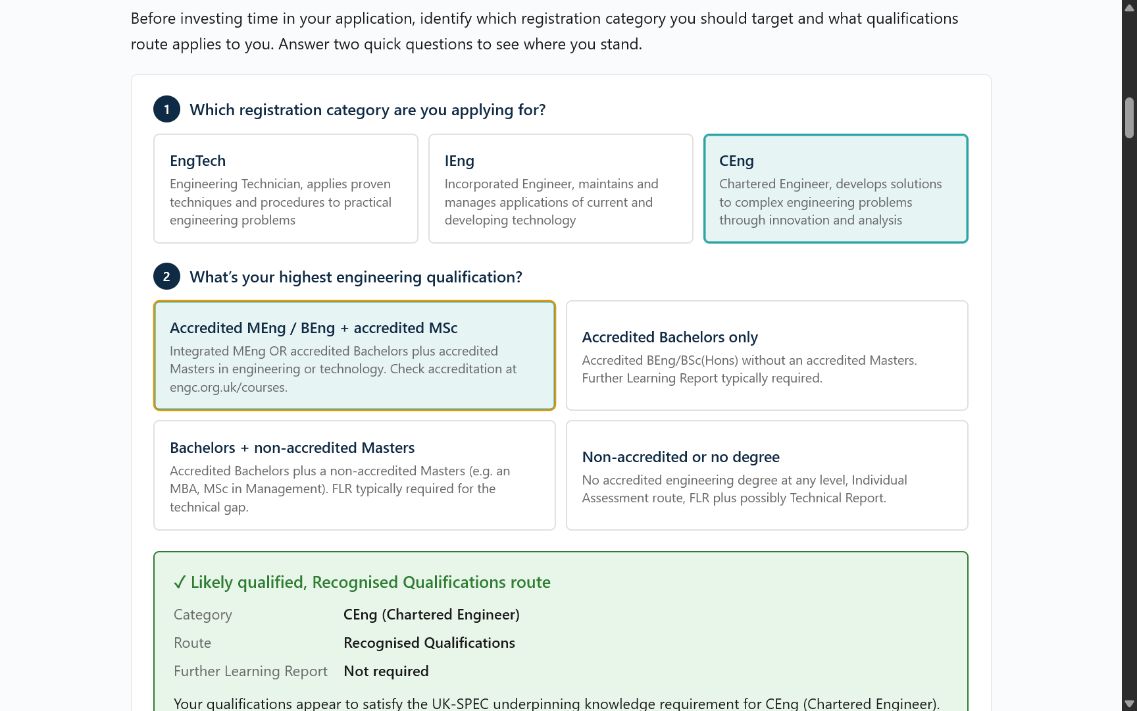
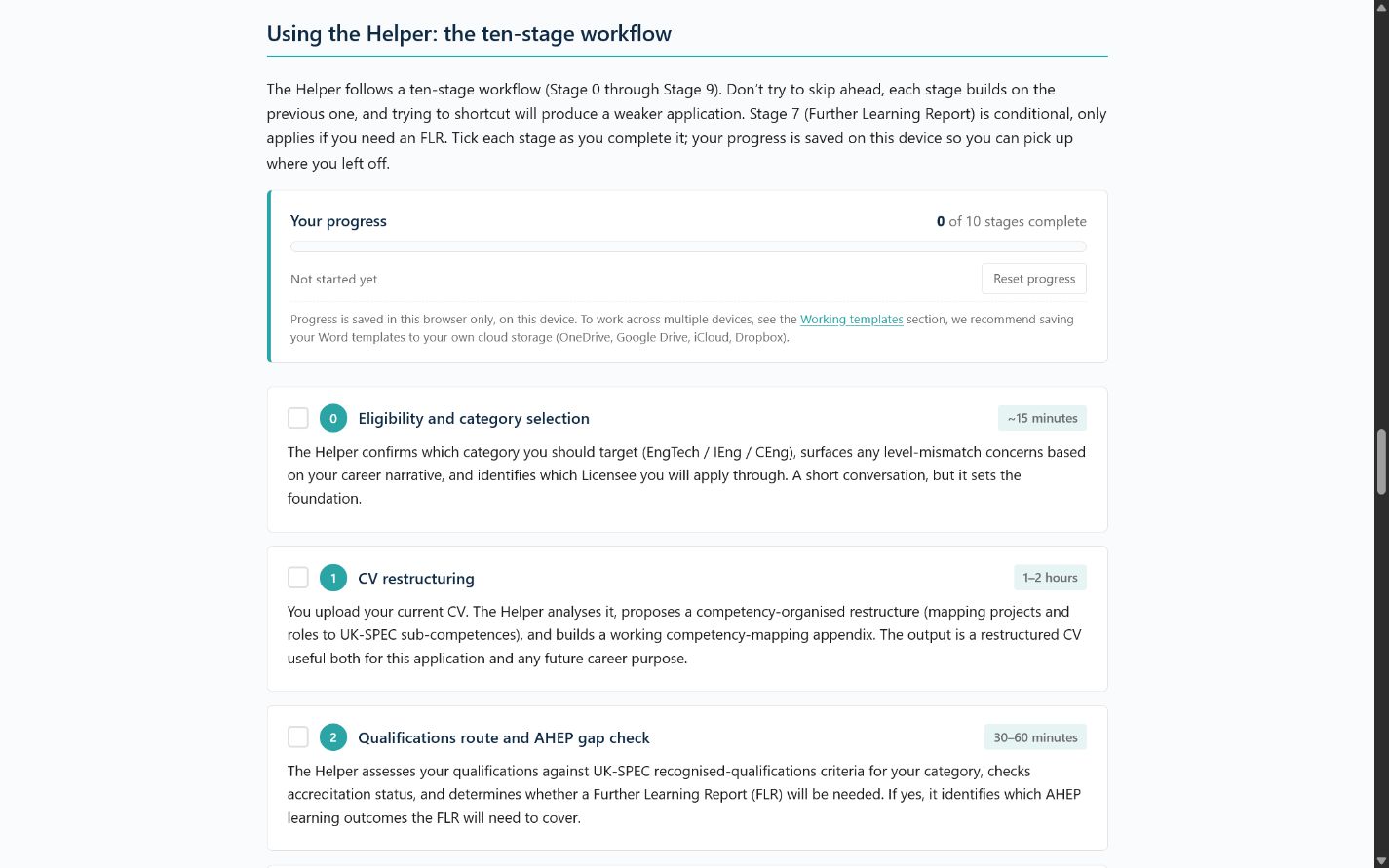
Sample
This example shows the editing pattern used by the Helper. It is illustrative and must be adapted to your registration category and evidence.
Too vague
“I managed the project team and delivered the solution successfully.”
Evidence pattern
“I compared [technical options] against [criteria], selected [approach], secured agreement from [decision authority] and was accountable for [measurable technical result].”
Your job: identify the decision you personally made, the engineering basis and the result. Team size or project value is not a substitute for technical evidence.
What's in the bundle
A downloadable drafting kit for use during your application. It can be set up in Claude, ChatGPT or Copilot. An AI account is required, and a paid subscription is strongly recommended for fewer interruptions and access to more capable models. Use only an account and service approved for the information you intend to process.
AI Project setup
A bounded AI-assisted drafting workflow organised into ten stages.
- Drafting-assistant system prompt with data and authority boundaries
- Ten-stage application workflow
- 14 knowledge files covering UK-SPEC, AHEP 4th edition, the Further Learning Report, pitfalls, CV transformation, and a plain-writing style guide
- Category-specific guidance for EngTech, IEng, and CEng
Application reference documents
Four Word documents showing the kind of information you may need to prepare.
- Competence Statement (covers all three categories)
- Application Form
- Further Learning Report (AHEP-mapped)
- CPD Record & Plan
These documents are for reference only. Start your application with your chosen Licensee and use its official forms. Use these documents only to understand and prepare the information you may need.
Customer resource page
A dedicated page on this site that walks you through using the Helper end to end.
- Step-by-step Claude Project setup
- Indicative category and route comparison
- Progress tracker for the ten-stage workflow
- Restricted-information warning and interview practice
How you'll use it
A ten-stage process from an indicative category comparison to interview practice. You provide and verify the evidence; the AI organises it against the supplied references. Stage 7 is used only if your chosen Licensee requests further-learning evidence.
Category comparison
Compare a non-sensitive career summary with the current EngTech, IEng or CEng descriptors, then discuss the category with a Licensee.
CV restructuring
Organise your career history around UK-SPEC evidence. You may also find the resulting record useful when updating your CV or development plan.
Qualifications route
Record accreditation checks and prepare questions. Only your chosen Licensee can determine the route and any further-learning evidence.
Competence mapping
Map your projects and roles to each UK-SPEC sub-competence and identify where the available evidence is limited before drafting.
Competence Statement
Draft one or two specific examples per sub-competence using the four-element pattern. This stage contains most of the drafting.
References
Use current Licensee instructions to plan possible referees with placeholders, then confirm eligibility and arrangements directly.
CPD Record & Plan
Organise CPD material against the current period and fields stated by your chosen Licensee.
Further learning (if requested)
Use the Licensee-confirmed format and scope to organise your own learning and workplace evidence.
Self-review
Apply drafting and evidence-coverage checks, and list official decisions that still need confirmation.
PRI preparation
Compile the final package and rehearse short stories per sub-competence for the Professional Review Interview.
What you'll need to use this
You need an AI account to use the Helper. A paid plan is strongly recommended, but not required. Free tiers can work, although lower limits and less capable models may make setup and drafting slower. Supported options include:
- Claude, the reference platform used to develop the workflow
- ChatGPT, using its project workspace where available
- Microsoft Copilot, using its agent or workspace features where available
Provider features, limits and prices change, so check the current plan details before choosing. Step-by-step written setup walkthroughs for all three platforms are included. Use only a service, account and intended use approved for the information you intend to process. Do not upload classified, protectively marked, export-controlled, commercially restricted or employer-confidential material.
Ask the institution you are considering to confirm its current membership, grade and application requirements. The Helper cannot make those decisions.
Pricing
Professional Registration Helper
One-time payment · downloadable bundle · no recurring fees
- AI-assisted drafting workflow: system prompt + 14 knowledge files (works with Claude, ChatGPT or Copilot)
- Category-specific drafting references for EngTech, IEng and CEng
- Four Word reference documents, including an AHEP-mapped Further Learning Report reference
- Customer resource page with progress tracker, indicative route comparison and PRI practice
- Email support for questions about the resource
- Free updates as UK-SPEC, AHEP, or Engineering Council guidance evolves
One-time payment through secure Stripe checkout. No recurring fees to Systems Engineering Advisory. You supply your own AI account; any paid subscription is purchased separately from your chosen provider.
Frequently asked questions
Practical details about resource scope, AI requirements and access.
Does this Helper cover all three registration categories?
It provides drafting references for EngTech, IEng and CEng. Stage 0 compares a non-sensitive career summary with the current category descriptors, but it cannot select or confirm a category. Discuss the appropriate category with your chosen Licensee.
What's a Further Learning Report and will I need one?
Whether you need to demonstrate further learning, and whether the institution calls for an FLR, Technical Report or another assessment route, depends on your qualifications, dates and chosen Licensee. The Helper can organise facts and questions, but only the Licensee can confirm the route, document and outcomes required. Use Stage 7 only after that confirmation.
Do I need a paid AI subscription to use this?
No. You need an AI account, but a paid plan is a strong recommendation rather than a requirement.
Free tiers can work, but their lower message and file limits may interrupt the workflow, and the available models may be less capable. A paid plan usually makes setup and drafting faster and more consistent. Check the provider’s current limits before choosing.
The setup supports three providers:
- Claude, the reference platform used to develop the workflow
- ChatGPT
- Microsoft Copilot
Features, limits and prices vary. If you choose a paid plan, you pay the AI provider directly and can cancel it when you no longer need it.
Can I use this with ChatGPT or Copilot instead of Claude?
Yes. Setup is slightly different on each platform. Included with your purchase are step-by-step written setup walkthroughs for:
- Claude Projects
- ChatGPT Projects
- Microsoft Copilot Agents
The methodology and knowledge files are the same across all three. The instructions for preparing your application do not change based on which platform you choose.
Responses and limits vary between providers. Choose a service approved for your intended use and that you are comfortable using.
Will this guarantee my application succeeds?
No. The Professional Review decision belongs to the relevant Licensee and its assessors. The Helper provides structure and checks, but your evidence must come from your career and remain your responsibility.
What if my application is deferred?
If a panel asks for more evidence on specific sub-competences, an FLR or a different category, you can reuse the Helper, knowledge files and reference documents to revise the flagged sections. Follow the panel and Licensee instructions first.
What if my work is classified or commercially sensitive?
Do not enter classified, protectively marked, export-controlled, commercially restricted, NDA-covered or employer-confidential material into an AI service unless the information owner has explicitly approved the account, service and intended use. The Helper cannot detect restricted information or make it safe by generalising it. Prepare an approved, redacted version outside the AI service, use placeholders, and confirm acceptable evidence directly with your information owner and chosen Licensee.
Who's building this?
This resource was built by a UK-based, CSEP-certified systems engineer with more than 15 years of engineering practice across complex programmes. It follows UK-SPEC, the Engineering Council’s published requirements and the AHEP learning outcomes.
Systems Engineering Advisory is an independent, one-person business. Direct contact at info@systemsadvisory.co.uk reaches me.
Should I buy this alongside another resource?
If you're a systems engineer also targeting INCOSE CSEP certification, see the CSEP Application Helper. It covers the INCOSE international certification, which has a different framework and process. The two resources are complementary if you want both UK professional registration and INCOSE CSEP certification.